
Forget the Labyrinth
Art, writing, and “oracular AI”

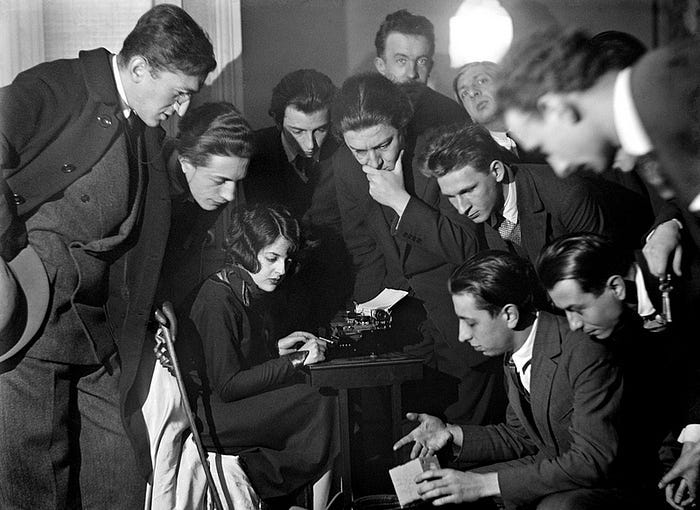
The glass mouth sucks blood-heat from my forefinger / The old god dribbles, in return, his words. – Sylvia Plath, Ouija
AI’s primary value may lie not in its adherence to forces of rationalization, to knowledge, but in its relation to “nonknowledge”, to its “blackbox” quality. In The Politics of Divination, Neoliberal Endgame and the Religion of Contingency, philosopher Joshua Ramey summarizes nonknowledge’s relationship to political economy and society thusly:
…the neoliberal era (is) a transition from a knowledge-based to a nonknowledge-based economy, from an economy based on prediction and control to one based on the exploitation of uncertainty, as such. The term “nonknowledge” was developed in the work of George Bataille. What Bataille meant by nonknowledge was not ignorance, but the uncanny presence of forces, potentials, and realities that solicit responses prior to both knowledge and ignorance. Nonknowledge is not unreasonableness, but is arguably the intuitive, empathic consciousness required for creative improvisation, manifested in laughter and tears, and signified in otherwise unaccountable sorrow, joy, longing, hope, despair and inspiration.
Following Ramey, it could be said that generative AI is a formalization of nonknowledge related to pre-modern divinatory practices–practices that allowed humans to go beyond everyday perception and intuition. Ramey understands neoliberal hyper-financialization — the collapse of all of society into conformity with the essential nonknowability of the market — as a mask for continued human reliance on ancient forms of divination in the face of the unknown:
Emile Durkheim argued that the primary function of ritual was to enable a community to deal with uncertainty by subsuming disruptive events — illness, death, natural disasters — within mythical patterns, orders that attuned the community to a harmonics within which it might find reassurance against pain, misfortune, and catastrophe, and in terms of which such events might be rendered meaningful. Put somewhat abstractly, ritual practices instantiate a basic religiosity necessary to society. What is sacred is some basic or minimal attitude that takes the unforeseeable and the unpredictable not as cause for despair but as occasions for making or continuing to try to make meaning. Divination is first among these practices.
In a perversion/extension of Bataille’s original realm of nonknowability — “the sacred” (“the accursed share”) — the new priests are neoliberal market leaders and entrepreneurs, their utterances in the face of the essential/generative unknowability and esoteric exigencies of the market the only reliable interpretations of the new god. Per Ramey:
…experts in the economy — paradigmatically entrepreneurs and arbitrageurs — cannot really know anything except how not to interfere with the complexity of magical market “meta-information processing.”… In the neoliberal era of hyper-financialized capital, the unknown and unknowable have not really been “managed” at all, let alone understood. Rather, the uncertain has been systematically exploited. And effectively, the future for most of us has been canceled.
The very power decried by the forces of human interpretability and social rationalization (so-called “ethical AI”) –this essential formalization of nonknowability–is what gives generative AI its jouissance.
In Resisting AI, Dan McQuillan reminds us that:
AI is never separate from the assembly of institutional arrangements that need to be in place for it to make an impact in society. Likewise, these institutions are immersed in wider frameworks of understanding that carry implicit and explicit assumptions about how the world is to be differentiated and valued. AI…is this layered and interdependent arrangement of technology, institutions and ideology.
Contemporary artistic production is one such institutional arrangement and the fast-mutating institutions comprising Ramey’s neoliberal endgame (including the artworld) are increasingly locked in reciprocal embrace with the divinatory/productive power of formalized nonknowledge that is embodied by generative AI.
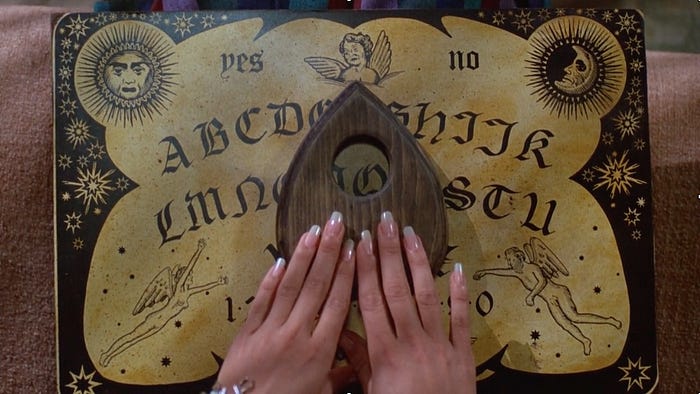
FORGET THE LABYRINTH AND / IGNORE WHAT MANNER OF BEAST / MIGHT RANGE IN IT –Sylvia Plath, Dialogue over a Ouija Board
The blood jet is poetry/there’s no stopping it – Sylvia Plath, Kindness
In the early-to-mid-20th Century, a subset of Modernist artists, faced perhaps with the limits of autonomous invention, improvisation, and intuitive thought and action increasingly turned to oracles, seers, aleatory systems and other forms of nonknowledge: W.B. Yeats, Le Bureau de Recherches Surréalistes, Sylvia Plath, James Merrill, William S. Burroughs, Brion Gyson, and John Cage all incorporated “oracles” into their work. In Yeats’ poem A Vision, this was accomplished by way of spirit mediums; for the Bureau of Surrealist Research, the “typewriter séance”; for Plath and Merrill, the Ouija board; for Burroughs and Gysin, the Cut-Up; for Cage, the I-Ching. Jean Arp, Marcel Duchamp, Lee Krasner, and Jackson Pollock all incorporated heavy doses of aleatory and chance procedures in their work. In the latter half of the century, Ishmael Reed, Betye Saar, and Suzanne Treister all incorporated pre-modern oracular procedures into their “postmodern” work.
In Ghostwriting Modernism, an examination of Spiritualism’s influence on art, Helen Sword suggests that Yeats’ interest in mediumistic communication was primarily informed by Modernist concerns:
…Yeats sought in the netherworld of the seance room not easy enlightenment but a confirmation of his belief in the slipperiness of human consciousness, the precariousness of language, and the overwhelming complexity of modern life. Especially from 1911 onward, when he first began to experiment with spiritualism in earnest, he explored through his writings on spiritualism such prototypically modernist concerns as textual materialism, physical and psychic fragmentation, the ambiguities of gender identity, the generative nature of contradiction and paradox, the role of the unconscious in literary production, and the violent yet vital interchange between high art and popular culture.
In the 21st Century, contemporary artists and writers, “sick unto death” with the metastasizing forces of rationalization and lightning-speed abstraction/dissemination of domination, increasingly employ “oracular AI”, large language models (LLM’s), diffusion models, generative adverserial nets (GANs), and others varieties of style transfer in their work. This fascination with / tarrying with the algorithm, this seemingly spontaneous intercourse with the “nonknowledge” pouring forth from the “blackbox” feels something like an autonomic twitch-response in the face of the overwhelming force of technoscience’s Power Laws. Perhaps in the face of AI-induced market pressure, artists have begun to compulsively chip off a tiny piece of that power for themselves, maintaining remnant “Powers of Art”, of the “Cosmic”, of “Life”. Per Ramey:
At the heart of neoliberalism is a divinatory practice, a political theology that identifies arbitrary, unforeseeable changes in market conditions with divinely ordained order. This ideology justifies austerity, the maintenance of debts, and even ecological devastation, reading them as cosmic inevitabilities it is irrational to question. The reading of markets as destiny is a form of divination, one that trades on a deep equivocation between knowledge and ignorance, where knowledge of market forces has become identical to effective surrender (through strategic nonknowledge) to the unknowable and unpredictable movements of markets.
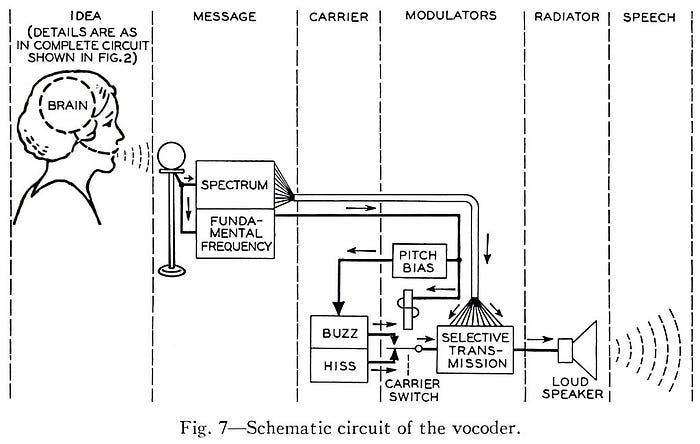
ITC, EVP, Spirit Box, Voicebox, Vocoder, Autotune
Every medium opens up a continuum from technology to magic and back again. Magic is just another name for a future, an as-yet unknown medium, a logic identified by both Arthur C. Clarke — ‘Any sufficiently advanced technology becomes indistinguishable from magic’ — and Samuel R. Delany: ‘At the material level, our technology is becoming more and more like magic.’ — Kodwo Eshun, More Brilliant than the Sun, Adventures in Sonic Fiction
Instrumental TransCommunication (ITC) is a rebranding of the earlier parascientific/paranormal research methodology EVP, or Electronic Voice Phenomena, which searched electronic signals for communications from the dead. Popularized by Konstantin Raudive’s book Breakthrough, the idea of electronically communicating with the dead surged during the last third of the 20th Century and has recently had a minor resurgence due to television shows featuring the technological investigation of the paranormal. The best known ITC devices, Spirit Boxes, are essentially radio scanners that skip through radio bands at a user-selectable speed.
Per Raudive, electronics signals, especially those on the the radio spectrum, are employed by the dead to communicate with the living. The degraded quality of many of the communications and ‘voices’ were believed by Raudive to be the result not just of the difficulty of communicating from beyond the veil, but also of the degraded, literally dehumanized quality of the dead.
…Roger Troutman’s voice is all vowel, an eesysquezy squidge of phonoglutamate, voco-concentrate. The synthesizer passes through his vocal tract. […] The vocoder generates a menagerie of machine voices, nonhuman subjects. These voices aren’t anempathetic or robotic. Rather they are disconcertingly oral, larynx machines, synthetic pharynxes that stretch the vowels into plastic.
— Kodwo Eshun, More Brilliant than the Sun, Adventures in Sonic Fiction
The Voicebox, the Vocoder, and Autotune all render the human voice uncanny–robotic, alienized, sometimes angelic. Thenexaggerated use of Autotune in popular music renders the singers’ voice somewhere between Raudive’s dehumanized dead and superhuman. The human voice, the earliest, most basic, universal musical instrument, is transformed into something more or less than human. This technological ‘dehumanization’ or ‘superhumanization’, judging by the popularity of Autotune in popular music, triggers a sort of technojouissance in the listener, whereas its more jarring use–roboticizing, alienizing, or rendering the voice nearly or wholly unintelligible–results in a sense of alienation/alienization that mirrors the claims of ITC/EVP and Raudive’s contention that the dead are literally dehumanized.
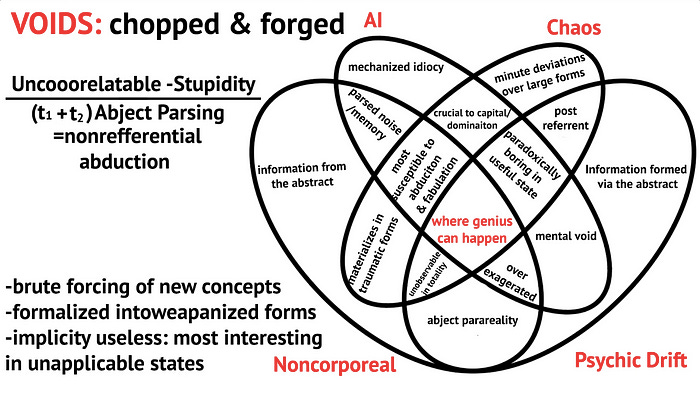
Alan S. Tofighi’s Mind Game’d, 2023
Alan S. Tofighi’s performances are “carefully constructed formalizations/realizations of ongoing investigations into anomalous, epistemologically marginal phenomena and the subcultures/epistemic bubbles surrounding them, often punctuated by strange personal experiences and anecdotes, highly subjective accounts, obsessions.”¹ Mind Game’d, 2023, filters Tofighi’s research into predictive technology and the 20th Century “Psychic Cold War” between the U.S. and Soviet Union (including Operations Grillflame, Stargate, and other “remote viewing” projects, Princeton’s Engineering Anomalies Lab (PEAR Lab) etc.) through a variety of voice-altering vocal devices–primarily a vocoder and a noise-gate–to startling, sometimes near-unintelligible effect. Tofighi’s conflation of voice-altering electronics and Cold War-era state-sponsored psychic experimentation is apt. Per Helen Sword:
Numerous scholars have noted the historical and thematic parallels between the rise of spiritualism in the late nineteenth century and the simultaneous development of new communications technologies, including mass-circulation newspapers, the telegraph, and wireless radio. The Society for Psychical Research (SPR) was founded by scientists who hoped to find material explanations for spiritualist phenomena, and spiritualists typically employed (and employ to this day) scientific, highly technical language to explain the mechanics of spirit communication.
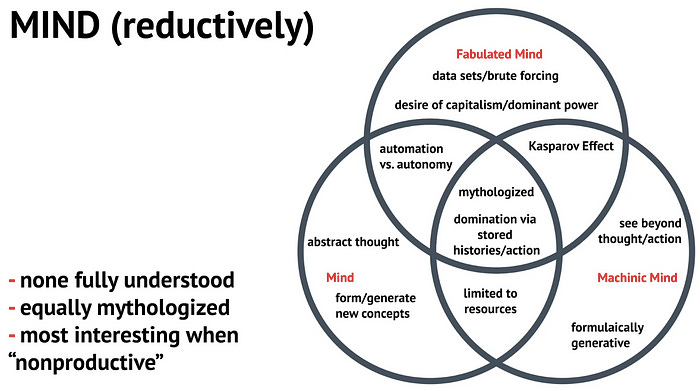
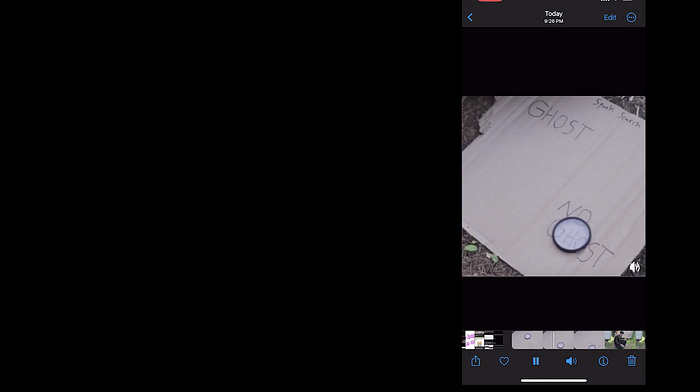
The video accompanying/augmenting the Mind Game’d performance is punctuated by diagrams and film clips illustrating Tofighi’s semi-intellible speech. Throughout the performance, he pulls objects related to the subject at-hand from from his coat pockets: a laser pointer, various unrecognizable eletronics, culminating with a random-number generator which he contemplates momentarily and unceremoniously discards…
¹I examine Tofighi’s work at length in Lazarus Canary: Thigmomorphogenesis, World Knots, and Psi Chicks in the deep-dive work of Alan S. Tofighi
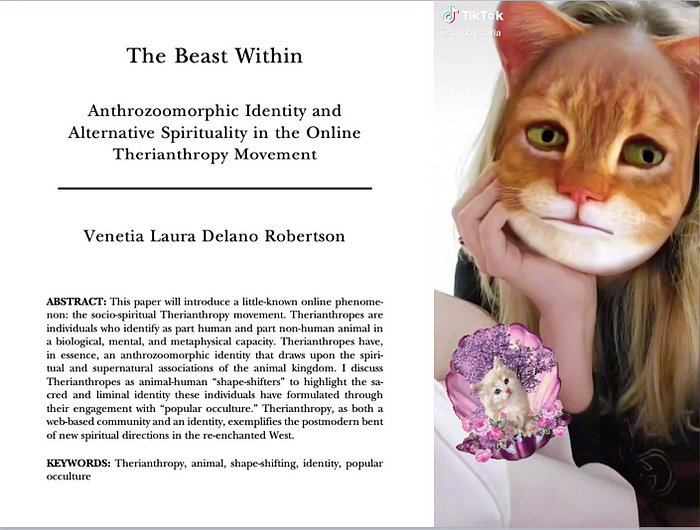
As Time Splinters into Zero and One, 2023, Kathi Schulz’ performance Therianthropy / Web Archeology
ANTHROZOOMORPHIC IDENTITIES IN HISTORICAL PERSPECTIVE, Venetia Delano Robertson:
Cultures worldwide have shape-shifters in their mythologies: the kitsune of Japan, the selkie of Scottish and Icelandic legend, the nahual of Mesoamerica, the Norse berserkers or úlfhéðnar, and of course the lycanthrope, or werewolf, from Europe. In addition, Paul Christian, without much explanation or ceremony, lists the werejaguar and werealligator of West Africa, the weretiger in India, the werecoyote in America, the werejackal in Egypt, and the weredingo in Australia.
Modern Therianthropes reference the mythical figure of the animal-human shape-shifter by calling themselves “shifters” or, sometimes, “weres,” evoking the most famous transmogrifying creature in the Western imagination, the werewolf. The recurring motif of cross-species transformation is found in the oldest recorded story, The Epic of Gilgamesh, fragments of which date as far back as 2150 BCE.
The label “Therianthrope” and the Therianthropy movement are first and foremost concerned with identity, an identity that is particularly complex because it is both hybrid and protean. The Therianthrope is a “beast-human” but also a “shifter,” which suggests a state of flux. This fragmentation of identity is one of the “dilemmas of the self ” that Anthony Giddens feels late (or post) modernity has instigated.
The Internet with its expressive capacities, according to psychologist Sherry Turkle, is “contributing to a general reconsideration of traditional, unitary notions of identity.” The complex nature of the Therianthrope, so often mediated online, is indicative of this shift towards the fragmentary self, but Therians seem to revel in the faultlines.
Kathi Schulz’ As Time Splinters into Zero and One suggests Turkle’s “general reconsideration of traditional, unitary notions of identity.” through the use of Snap, Tiktok, and Instagram filters and the still-accessible “voices” emanating from “dead” websites — sites built on dead platforms, employing outdated protocols, sites that haven’t been maintained or updated by their authors in decades…
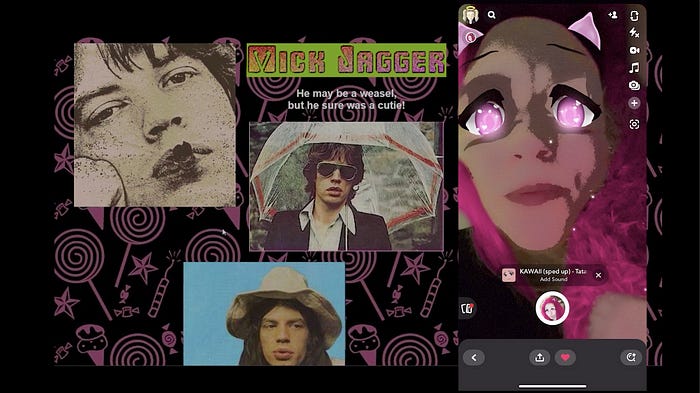
Throughout the performance, Schulz live-swaps Snapchat filters, assuming a staggering variety of personae while scrolling through an array of “dead” websites – all locked into the aesthetics, concerns, and protocols of bygone web eras. The fragmentation is furthered by her poetic, sometimes ‘disconnected’ speech. Schulz — covered in a blanket, clutching a phone– lies on the floor in front of the projection screen, her filter-altered face projected above her prone body, while her strangely disembodied voice resonates through the speakers.
Per Venetia Delano Robertson:
Fragmentation is translated into liminality, making the Therian not just a shape-shifter but one who is, as Victor Turner said, “betwixt and between,” a walker between worlds, or as Therian writer Quil muses, with “one paw in the galaxies, one paw on the earth.”
In recent years, art, in its elite institutional form within the artworld, has been increasingly correlated with the logic of Ramey’s neoliberal endgame (that this is a revelation suggests serious atrophy in contemporary historical consciousness.) Even art that offers strong morphological resistance to marketability has found itself easily absorbed by the market (water-stained photostats by first-gen Conceptualists, the shriveled remains of Eva Hesse’s, questionable remnants from once-great estates idolated like the shriveled fingers of medieval saints or splinters of the (multiplicitous) “true cross”.) Both Lucy Lippard and Benjamin Buchloh have expressed surprised dismay at the collectability of even the most dematerialized of artworks. Artists operating within the openly market-defined artworld have remained mostly silent in the face of the overcoding of all artmaking with the logic of marketmaking.
Canny, market-focused artists — ashen-tongued — have their reward. Art that is authentically futurological, that does not adhere (merely) to market-value (accumulation, speculation, arbitrage) or entirely foreswear the lure of oracular AI with its portal to the Matmos of nonknowledge, is probably art (as it always-already has been) driven by compulsion. Per Plath and her spectral companions: “forget the labyrinth”…“the bloodjet is poetry, there’s no stopping it.”
Sylvia Plath, Oujia, from Crossing the Water, New York: Harper & Row, 1976.
Percy Bysshe Shelley, A Defence of Poetry, 1821.
Joshua Ramey, The Politics of Divination, Neoliberal Endgame and the Religion of Contingency. London: Rowman & Littlefield, 2016.
Dan McQuillan, Resisting AI. Bristol, UK: Bristol University Press, 2022.
Sylvia Plath, Dialogue over a Ouija Board and Kindness from The Collected Poems. London: Faber & Faber, 1981.
Helen Sword, Ghostwriting Modernism. Ithaca: Cornell University Press, 2002
Kodwo Eshun, More Brilliant than the Sun, Adventures in Sonic Fiction. London: Quartet Books, 1998