
Lemurians

The unseen world beneath our feet, malignant and horrible, is complete in its mastery of Earth. — Richard Shaver
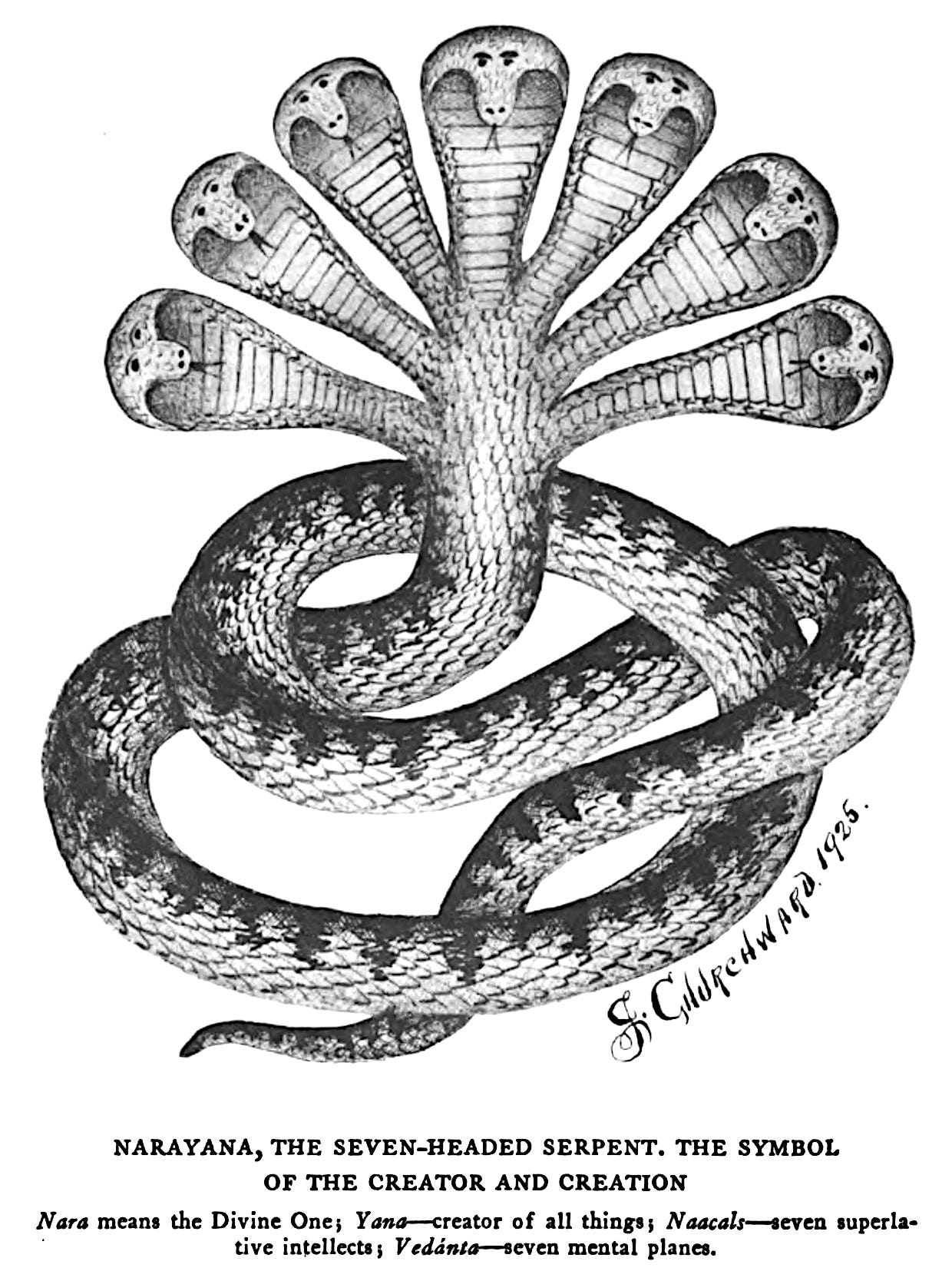
The Symbionese Liberation Army was a radical American leftist group that, in the mid-1970s, adopted James Churchward’s drawing of the seven-headed Narayana from his book The Lost Continent of Mu (above) as their flag. Churchward’s decipherment of the image: "Narayana , the Seven-headed Intellect, the Creator of all things throughout the universe, created man, and placed within his body a living, imperishable spirit, and man became like Narayana in intellectual power. ” was replaced by the SLA with their own explanation: each cobra head represented one of the seven principles of Kwanzaa.
The subject of The Lost Continent of Mu was originally introduced by Augustus Le Plongeon in the mid-19th Century. Plongeon identified the “lost continent” with the Atlantic Ocean and the Mayan civilization. Churchward relocated it to the South Pacific, identifying it with another “lost continent”— that of Lemuria. In the late-19th Century, the zoologist Philip Sclater and the biologist Ernst Haeckel lent credence to the Lemuria legend: Sclater through the discovery of lemur fossils in locations separated by bodies of water suggesting a lost land-bridge, and Haeckel through his belief in a lost common ancestor to humanity.
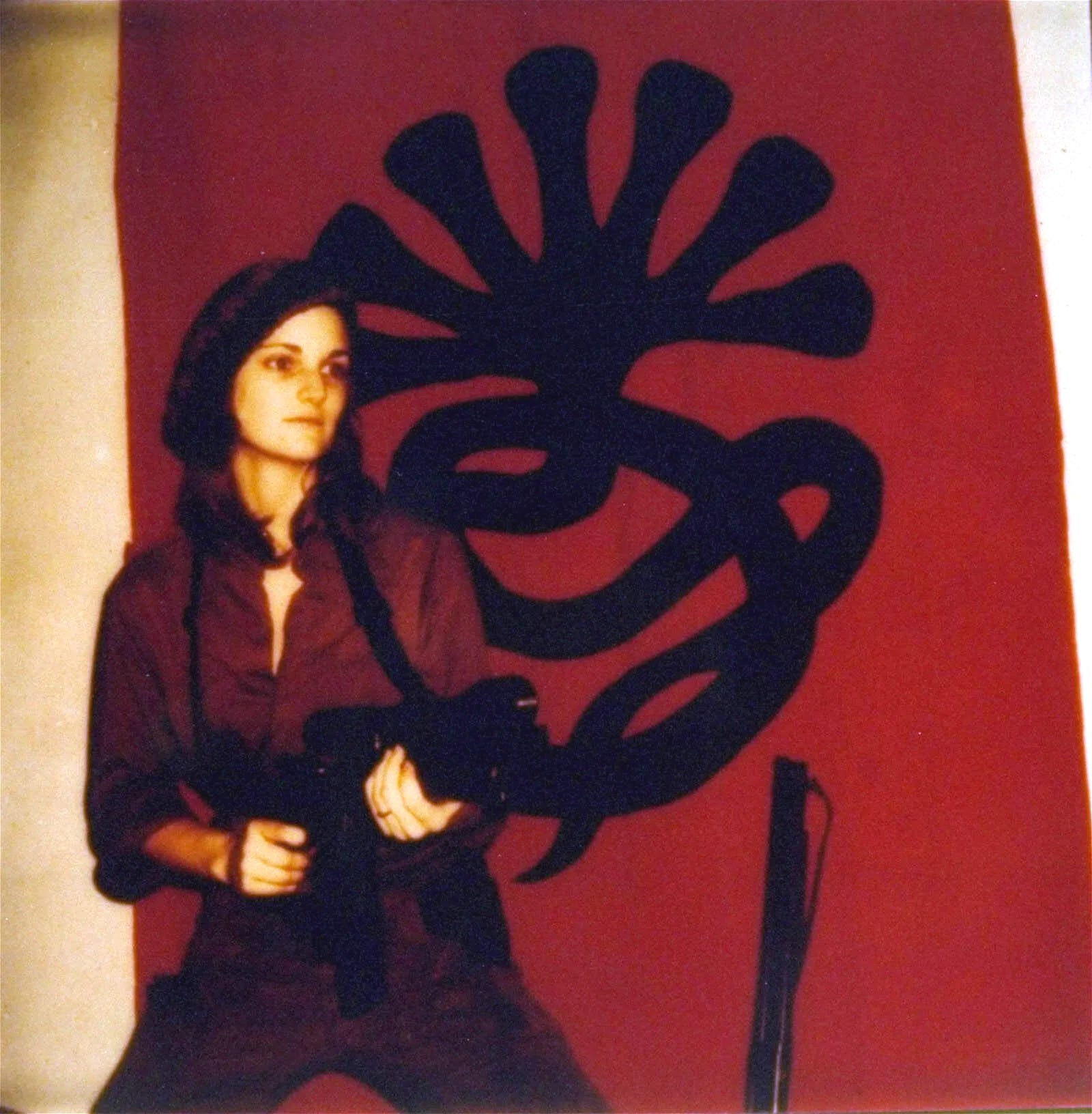
The Symbionese Liberation Army was perhaps the most spectacular of the violent revolutionary groups that formed in late 1960s-early 1970s America. Their broad-daylight assassination of Oakland school board superintendent Marcus Foster and their hours-long shootout with a massive L.A. police force created media firestorms, but their single most dramatic act was the kidnapping and subsequent “conversion” of the heiress Patricia Hearst into the revolutionary Tania (above).
In addition to their sensationalism, the SLA was among the weirdest of the violent revolutionary groups: their name “Symbionese Liberation Army” contains the invented neologism “Symbionese”, their flag is a copy of Churchward’s drawing of the Narayana of Mu (said to have been traced directly from The Lost Continent of Mu by Mizmoon, one of the revolutionaries), the group’s slogan “Death to the fascist insect that preys upon the life of the people!” is florid, over-the-top, suggestive of malicious (alien, reptilian, insectoid) lifeforms that dominate the fringes of today’s conspiracy culture.
Death to the fascist insect that preys upon the life of the people! – Symbionese Liberation Army slogan
In Revolution's End, The Patty Hearst Kidnapping, Mind Control and Secret History of Donald Defreeze and the SLA, Brad Shreiber illuminates the paranoia and “paranormal” beliefs that fueled the SLA:
Patty Hearst gave a clear picture of the paranoia and distrust that ruled DeFreeze’s life during that time. She recounted how, during SLA meetings, he made the group turn the television toward the wall, because he believed that the government could use it to spy on them.
Hearst also offered candid insight into the mind of General Field Marshal Cinque during an appearance on the Larry King Show on CNN. She spoke of the fear Cinque instilled in her while an SLA captive. “It was considered wrong of me to think about my family. When Cinque was around, he didn’t want me thinking about rescue because he thought that brainwaves could be read, or, you know, they’d get a psychic in to find me. I was even afraid of that.”
The group’s communiqués, often surreal collages of revolutionary rhetoric, non-existent technologies (the first communiqué, following the assassination of Marcus Foster, accused him of implementing “Bio-Dossiers through the Forced Youth Identification Program” and an “Internal Warfare Identification Computer System” in Oakland schools), and intense, quixotic charges against their targets. Their shifting ransom demands for Patty Hearst, baroque and often impossible to implement, were further examples of the unhinged nature of the project. Every public act of the SLA was spectacular, strange, and drew corresponding media attention.
Schreiber suggests that the group was designed to court exactly such attention but not to any “revolutionary” ends. He sees instead something more in line with acknowledged government counter-insurgency operations of the time: the FBI’s COINTELPRO and CIA’s MHCHAOS:
The Symbionese Liberation Army exceeded the expectations of its creators, the Central Intelligence Agency and the California Department of Corrections. For it not only infiltrated remnants of the New Left but also destroyed the credibility of a legitimate progressive movement that protested racism, sexism, the Vietnam War and any form of societal inequality.1
Many radical groups of the time identified with some sort of “underground” imaginary. Often they identified with the underground in both the countercultural sense and the sense of the Underground Railroad of the previous century, suggesting a hidden liberatory network operating beneath the “surface” culture. For the SLA to identify with “actual” subterraneans through their use of the Mu flag was a degree or two weirder, more sensational.
19th Century mystic and founder of Theosophy, Helena Petrovna Blavatsky’s Secret Doctine lists the Lemurians as the Third Root Race, inhabiting the Earth millions of years before humans. In Erica Lagalisse’s Occult Features of Anarchism With Attention to the Conspiracy of Kings and the Conspiracy of the Peoples, she examines Theosophy’s impact on the anarchists and other political revolutionaries of the 19th Century and early 20th Century:
The theosophy of Helena Pavlova Blavatsky (1831–1891), which intrigued many anarchists, involved a teleology of divine evolution represented by successive “root races” whose finality was cosmic union. Novelist Leo Tolstoy (1828–1910), a theosophist and anarchist who wrote a tract titled “The Kingdom of God Is within You” (1894), also admired (Nikolai) Federov (1828–1903), who wrote that the common task of humanity was to use science to resurrect its dead fathers from particles scattered in cosmic dust. Chulkov, Berdyaev, and Ivanov, contemporaries of both Fedorov and Tolstoy during the Russian occult revival, all posited a “mystical anarchism” that equated political revolution with realignment in the cosmic sphere. In England, union organizer and early feminist Annie Besant, who organized women matchmakers and fought to open the Masonic lodges to women, was convinced she was the reincarnation of Giordano Bruno, and it was theosophy that inspired her to fight for Home Rule in India. It was also through theosophy that she met Jawaharlal Nehru, himself a member of the Theosophical Society. Just as socialists were attracted to the occult, spiritualists and mediums of all kinds, who were disproportionately women, were led by their spiritual views to engage the “social question.” 2
“Jacques, Jacques, had to move that rock.”—David Lynch
According to the philosopher Todd McGowan, David Lynch is the filmmaker of the unconscious, specifically of the repressed unconscious posited by Jacques Lacan: “The desire to see, Lynch suggests, is connected to an unconscious desire that we do not avow.”
And, following Lacan:
Though consciously the subject may remain fixated on the ideal of complete enjoyment, the unconscious drives the subject toward another form of enjoyment. Since enjoyment can only be partial and depends on the experience of absence, the subject disappointed with the atternpt to achieve complete enjoyment soon works unconsciously to create the loss uf the object whereby enjoyment will become possible.”3
Lynch’s films are catalogs of repressed desires directed into “another form of enjoyment”, often this form of enjoyment is pure id: in Lost Highway, Mr. Eddie acts out every driver’s repressed desire to humiliate and punish the tailgater; in Blue Velvet, Frank’s sadistic, nitrous-fueled mating ritual culminating with “Mommy…Baby wants to fuck…” would shock Oedipus.
In Interrogating the Master: Lacan and Radical Politics, Saul Newman examines the potential for radical politics of Lacanian psychoanalysis:
…from a Lacanian perspective, there is a structural link between the position of the revolutionist and the position of the Master — one implying the other. It is precisely this hidden connection between revolutionary desire and the domination it contests, between transgression and authority, that is the central problem of revolutionary political theories like anarchism, and which must be uncovered and explored if radical politics is to avoid the perpetuation of power.
In exploring this connection between revolutionary transgression and authority, we must turn to Lacan’s reformulation of Hegel’s Master/Slave dialectic…the ambiguous and hidden connection between revolutionary desire and authority. In Hegel’s dialectic, desire, which is really the desire of the self, is only realized through the desire of the other. In other words, what is desired is the recognition by the other of one’s own desire…because self- recognition is based on recognition by the other, the identity of the master – the one who is recognized – is dependent on the identity of the slave – the one who recognizes. This introduces into the relationship a paradoxical ambiguity and potential reversal of positions. We can see this precariousness in all relationships of political and social domination – the authority of the lord is always dependent on the recognition of this authority by the bondsman; without this it would collapse. 4
Following the success of Blue Velvet in the mid-1980s, Lynch was introduced by his agent to the screenwriter Mark Frost (Hill Street Blues). After two film projects imploded, Lynch and Frost pitched the tv networks on an FBI procedural about the resurfacing inhabitants of the “lost continent” of Lemuria. The pitch didn’t find traction and Lynch/Frost instead made Twin Peaks. Lynch:
The Lemurians was a thing Mark [Frost] and I were going to do as TV show. Based on the continent of Lemuria, which was fictitiously thought of as a very evil continent. It was sunk way before Atlantis even rose, sunk because they were so evil. Jacques Cousteau inadvertently moved a rock, very early in his travels, part of it was 'Jacques, Jacques, had to move that rock.' A lot of poems in it. Part of the lore surrounds the leaking of Lemurian essence from the bottom of the Pacific Ocean. Anyway, the essence is leaking, and becomes a threat to all goodness in the world. It's a comedy! 5
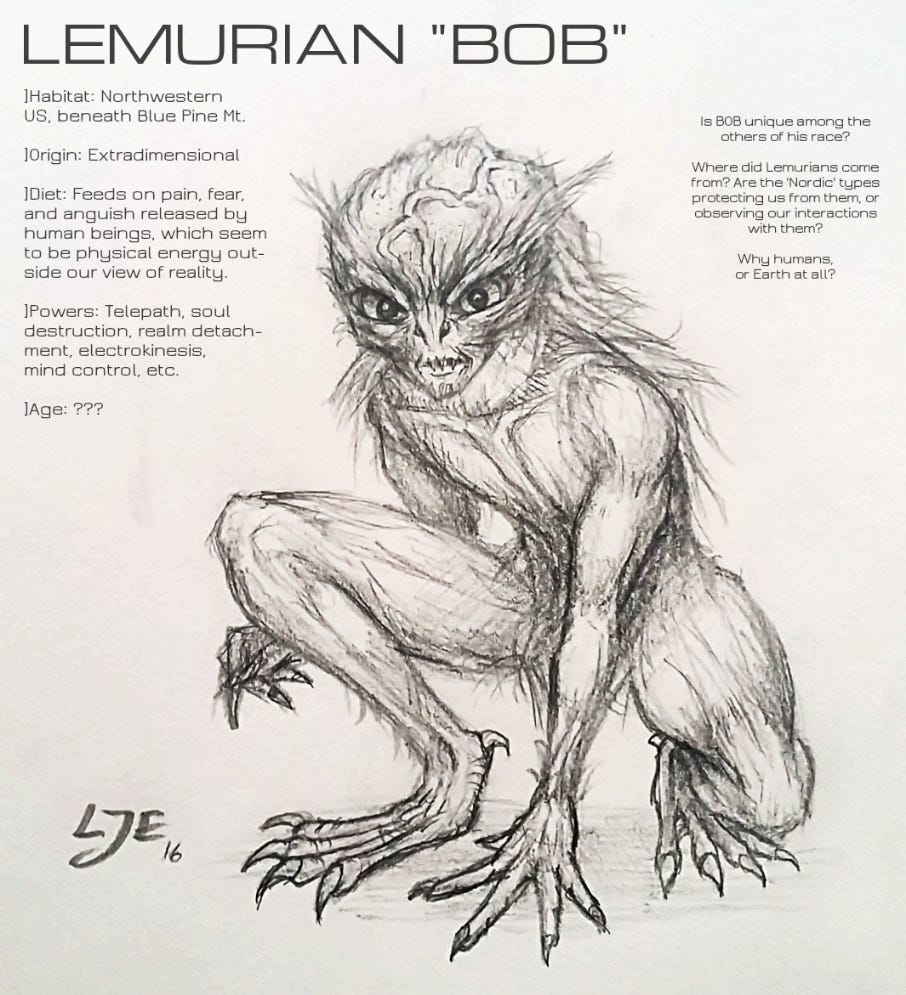
Redditor LlortorLJE’s Lemurian Bob (above) suggests not only that the Lemurian is aligned with the mysterious evil embodied by Twin Peaks’ interdimensional killer Bob but that the Lemurian and Bob are one and the same. Bob’s origin story is now legend: a set dresser, Frank Silva, was “locked” (Lynch’s word) in Laura Palmer’s house, having moved a large dresser against a door. His attempt to hide during the scene was caught on camera: a disheveled figure glimpsed in a mirror at the edge of the frame. Silva’s un-madeup, somewhat unkempt appearance, operating something like Lacan’s punctum, tore through the carefully produced illusion of the scene, fissuring the carefully constructed, fantasy-infused “reality” of the film and offering a glimpse of the real—Lacanian code for the terrifying, near-inaccessible ontological ground of consciousness—allowing it to break through for a moment.
For an instant, the insurmountable aesthetic divide between what goes on in front of the camera and what goes on behind and around it dissolved. The divide between the coifed talent onscreen and the accidental image of Silva, un-madeup, wild, jolted Lynch into a revelation about the hidden real breaking through, corrupting the film-image itself. This small invention/intervention, this tear in filmic reality, birthed Bob.

As Bob haunts the edges of the frame in Twin Peaks, the Lemurian lurks on the edges of human history. According to LJE’s wiki-style powerlisting, Lemurian Bob feeds on Garmonbozia, synonymous with the “pain and sorrow” (represented in Twin Peaks as creamed corn) that nourishes the evil interdimensional habitués of the Black Lodge. Lemurian Bob is thus in line with strains of Lemurian myth since the 19th Century. David Bushman, from Conversations With Mark Frost:
The Lemurians as Frost describes it, was “pretty out there; it made Twin Peaks look like Peyton Place.” Lemuria is the name of a mythical lost continent located in the Indian Ocean, as postulated not just by crackpot fabulists, but also, once upon a time, by certain reputable scientists.
Lemuria was originally hypothesized as a sunken land bridge between continents, to explain the discovery that the lemur, a predecessor of the monkey, had the same traits in South Africa, Madagascar, and India, even though these regions are separated by expansive bodies of water (according to Charles Darwin’s then- recently published Origin of the Species, the animal should have developed unique traits respective to the different environments).
In 1864, a British zoologist by the name of Philip Lutley Sclater proposed the appellation, in honor of the lemur. Later in the nineteenth entry, Ernst Haeckel, a Darwin paraclete and respected scientist in his own right, proposed that Lemurians were not just lemurs, but also humans, who had migrated to India as their continent sank, eventually evolving into the first Aryans.
Once scientists accepted the theories of plate tectonics and continental drift, Lemuria fell into general disrepute (difficult as that is to believe), but was embraced by occultists including James Churchward, who believed Lemuria to be the Edenic home to 64 million telepathic beings who had invented space travel and teleportation before its destruction in the year 10,000 BCE.
Theosophist Helena Petrovna Blavatsky— a prominent character in Frost’s 1993 novel, The List of Seven— claimed in her book The Secret Doctrine (1888) to have learned of Lemuria in The Book of Dzyan, which she said was composed in Atlantis and shown to her by survivors of that lost continent. Blavatsky described Lemurians—supposedly the third of seven “Root Races” of humankind—as seven-foot-tall, egg-laying hermaphrodites with psychic abilities and a third eye. According to Blavatsky, it was the Lemurians’ wickedness that caused their continent to sink into the sea.6
Lemurians were the 19th Century’s answer to Greek satyrs and maenads, the putti and archangels of the Renaissance, the Enochian angels of John Dee’s proto-Enlightenment, and the fae that haunted Ireland for centuries. They occupied the place in the human imagination that has been overtaken in the 21st Century by extra- and ultra-terrestrials, C.H.U.D.’s, orbs, and mystery drones. The underground that they inhabited had an even longer history, stretching back to the oracular tradition of the ancient Greeks.
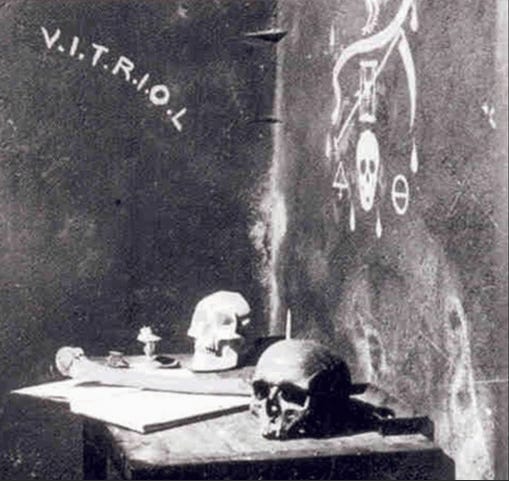
V.I.T.R.I.O.L "Visita Interiora Terrae Rectificando Invenies Occultum Lapidem" (Visit the interior of the earth and through purification you will find the hidden stone)
The Greeks were obsessed with the subterranean as the source of oracular knowledge:
Most oracular shrines included a subterranean chamber, but no trace of such has been found at Delphi, though the Pythia was always said to “descend.” At the oracle of Trophonius, discovered in 1967 at Levádhia, incubation (ritual sleep to induce a dream) was practiced in a hole. The most famous centre of incubation was that of Asclepius at Epidaurus. His temple was furnished with a hall where the sick were advised by the demigod in dreams.7
This tradition likely influenced the Freemasons’ subterranean “Chamber of Reflection” (above), outfitted with skulls, writing utensils, and the alchemical acronym V.I.T.R.I.O.L. ("Visita Interiora Terrae Rectificando Invenies Occultum Lapidem" (Visit the interior of the earth and through purification you will find the hidden stone)), which has, for centuries, acted as a sort of “incubator” for initiates reflecting on life, death, perfectability, and eternity.
In the 19th Century, during what could be called the birth pangs of demystification, Edward Bulwer-Lytton’s novel Vril: The Coming Race (1871) fueled popular interest in subterranean beings with strange powers. Bulwer-Lytton’s Vril-ya, an inner-Earth-dwelling mystical species tamed a special, secret energy, The Vril, and inspired 19th Century theosophy as well as consumer products like Bovril (below), a salty meat paste (now vegetarian).

In the mid-20th century, Richard Shaver’s writings occupied similar terrain: The Shaver Mystery sold tens of thousands of copies of the pulps Amazing Stories and Fantastic Adventures during the 1940s. Per Richard Toronto in War Over Lemuria:
On its face the Shaver Mystery was the promotion of a series of science fiction yarns that appeared in Amazing Stories and Fantastic Adventures magazines between 1945 and 1948, with Palmer as editor. It all began with a strange alphabet called Mantong, Earth’s “mother tongue.” It was an artifact Shaver “discovered” and developed over time.
Science fiction was already full of odd languages and slang. A.E. Van Vogt’s Sian novels popularized new slang terms among SF fans. The “universal language” of Esperanto gained popularity in SF circles as early as the 1930s…Language has always been the building block of any new movement, something that SF pulp writer L. Ron Hubbard knew when he fashioned Scientology.
The language key may be why Shaver sent his Mantong alphabet to Palmer. Shaver was not merely selling stories, he had a message for humanity. Nevertheless, Mantong was not what sparked the controversy. The controversy — the mystery— came from Shaver’s claim that his stories were based on facts acquired from another world. Hardcore SF fans found Shaver’s facts hard to swallow, though they were not the hoax everyone suspected.
Shaver’s facts were what placed him among other historical figures like William Blake, Pythagoras, Galileo, Luther, and Emanuel Swedenborg, all of whom dispensed similar facts that came from auditory and visual hallucinations. Put succinctly, Shaver heard voices. They were similar to the voices heard by luminaries like Joan of Arc and Philip K. Dick, and they gave Shaver information. They also gave him his mission in life. 8
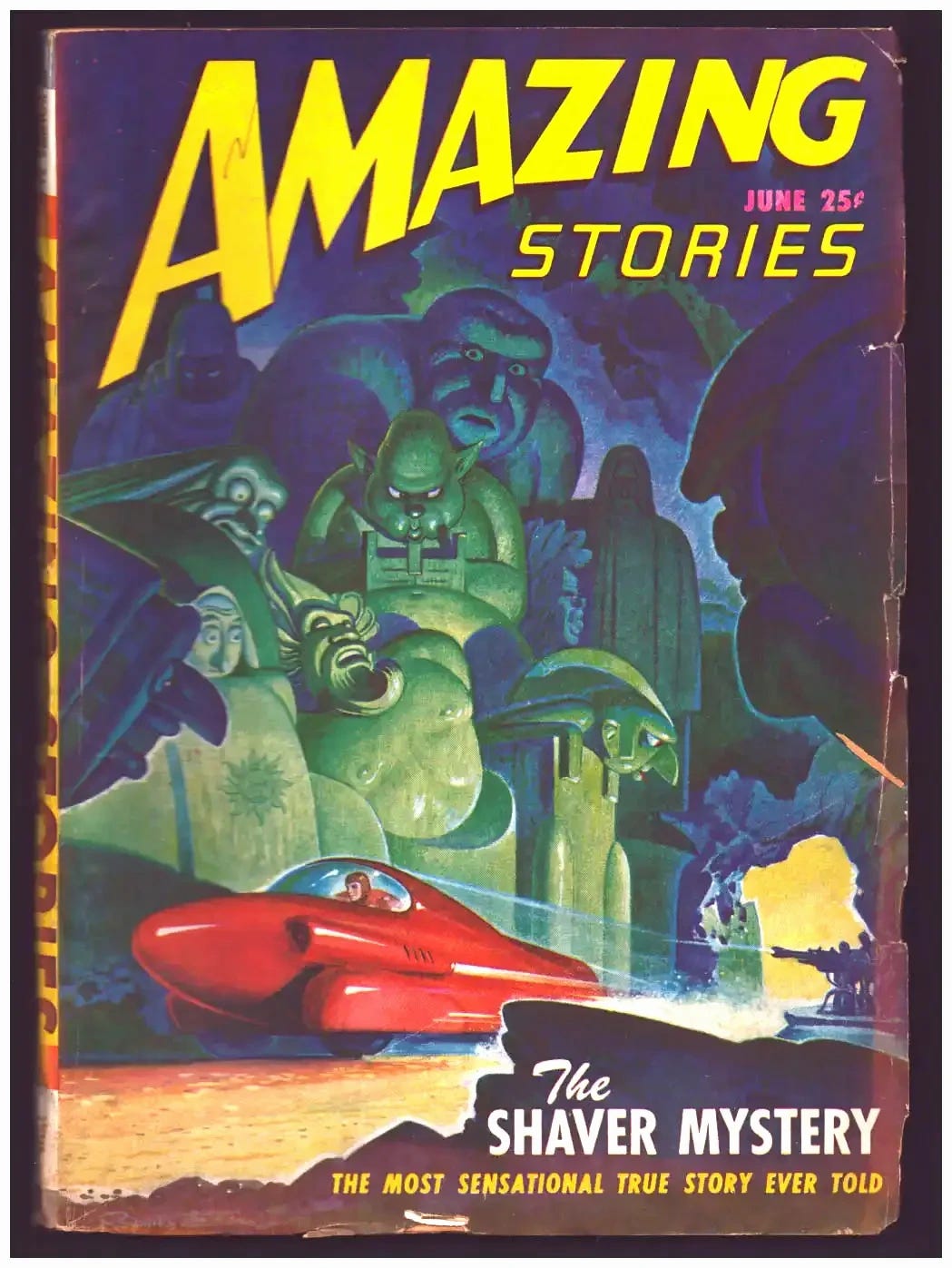
DETRIMENTAL ROBOTS
Shaver’s voices explained that prior to the Deluge of Noah, an advanced civilization flourished under the leadership of three races: the Atlans, Titans, and Nortans. These beings came from somewhere in deep space and lived happily on Earth until the neighborhood went to hell in a handbasket. The sun began to spew radioactive particles that were deadly to their existence. Their bodies — once immortal — began to age. […]
At first, they avoided the sun by retreating underground, constructing vast cavern systems within the Earth’s crust. This is where they lived and worked for many years, until finally leaving Earth forever, preferring the security of dark space, as far from our deadly sun as possible.
The cave people split into two groups: tero (positive) and dero (negative). Shaver’s Mantong alphabet defines a dero as a “detrimental robot,” that is, someone whose mind is controlled by the destructive emanations of the sun. Even worse, the deros have access to the Atlans’ incredible machines left behind in the caves. These “mech” as Shaver called them, now in the hands of deros, inflict invisible rays on surface folk even today, controlling us in various ways.
Mech can eavesdrop on one’s innermost thoughts, transmit physical sensations, healing rays, or instant death. A “telaug” mech can put thoughts into one’s mind. Unlike his fore bears, who explained voices as the word of God or angels, Shaver explained his voices within the framework of science fiction and emerging science.
In modern psychiatric jargon his telaug is explained as an “influencing machine,” a symptom of a popular 20th century psychosis called schizophrenia. Whether it was schizophrenia is not known for sure; I have not seen Shaver’s medical records. 9
Mark Frost’s 2016 novel The Secret History of Twin Peaks delves into Lemuria, Ray Palmer, and Richard Shaver’s Shaver Mystery and their influence on fringe science, popular, and conspiracy culture:
Richard Sharpe Shaver, a Pennsylvania welder and former hobo…claimed he had acquired secret knowledge of an earlier “progenitor” race of beings he called “Lemurians.” Palmer called these stories, collectively, “The Shaver Mystery.”
Shaver claimed it began in the early 1930s, when a peculiar frequency emanating from his welding gun allowed him to hear the thoughts of his coworkers. Not long afterwards he started picking up more sinister telepathic signals—in effect “downloading” extended dialogues almost like transcripts—from the aforementioned Lemurians.
Shaver’s strange narrative claimed that these Lemurians lived in vast underground cities--accessible only by caves and lava tubes, frequently set deep below dormant volcanoes throughout the world. Among these, supposedly, are Mt. Shasta and Mt. Rainier.10
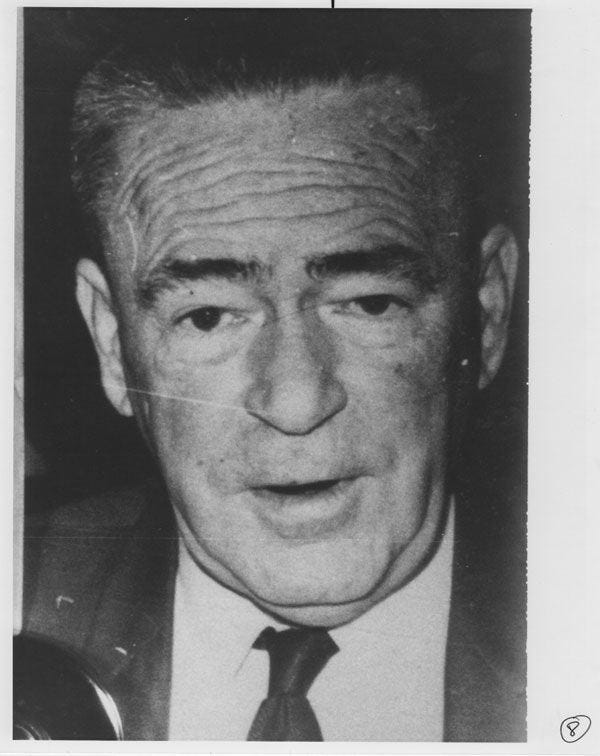
In another strange development in the Lemurian mythos, the mysterious, reactionary, intelligence-connected figure of Fred Crisman—linked to everything from the Maury Island U.F.O. incident to the JFK assassination—pops up in Amazing Stories. Per Mark Frost:
Soon after the Lemurian stories appeared…Ray Palmer published a letter in Amazing Stories from Fred Lee Crisman. In it, Crisman claimed that during his service in World War II, while on a top-secret mission, he stumbled across one of these so-called “Lemurian caves” in Burma, and barely escaped with his life.Crisman returned to the Tacoma area from his mysterious trip to Alaska and the following month, on September 8, the Air Force revoked his reserve commission.
A few months after his return, Crisman penned a second letter to Ray Palmer’s magazine Amazing Stories in which he claimed that sometime during this trip to Alaska he discovered a second “Lemurian”-style frozen cave while in the company of a soldier he identified only as “Dick” and, once again, barely escaped with his life. But this time, he claimed, his companion “Dick” was not as lucky, perishing from wounds from a “ray gun” wielded by whatever beings they encountered
Chicago magazine publisher Ray Palmer, who died in 1977, adds one last detail worth noting:
Just after the Maury Island incident, Fred Crisman mailed Palmer a cigar box filled with some of the metallic objects and rocks Harold Dahl had recovered. A few days after the crash of the B-25, Palmer claimed, a single intelligence agent visited him at his home unannounced. If the man mentioned which agency he represented, Palmer did not specify. He described the man as “average looking” and wearing a black suit, and that he “casually questioned me about the Maury Island incident and the Shaver-Lemurian articles.”
Palmer seems to be describing Crisman’s meeting with a representive of what later came to be known as the “Men in Black.” Crisman cuts a Zelig-like figure through the heart of paranormal, ufo, and conspiracy culture of the mid-20th Century, popping up again and again:
In 1947, Crisman was involved in the Maury Island incident, an early UFO hoax. Crisman's "fellow UFO witness" Harold Dahl believed the 1960s TV series, The Invaders was based on Crisman's life. Prior to this, Crisman had written to Amazing Stories magazine claiming that he battled "mysterious and evil" underground creatures to free himself from a cave in Burma during World War II…
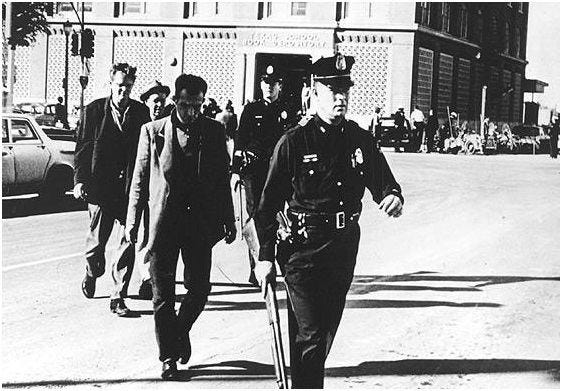
In 1969, Crisman was subpoenaed by Jim Garrison to testify in the case against Clay Shaw in the John F. Kennedy assassination. A photocopied document later circulated among Kennedy assassination buffs claimed that Crisman was one of the "three tramps" allegedly employed by a secret government agency. During this time, he hosted a radio talk show under the pseudonym "Jon Gold" and wrote a book, The Murder of a City, Tacoma published in 1970 through Transistor Publishing Company. The book was described by reviewer Michael Sullivan as a "weird, politically slanted rant" that manages to "tie corruption in Tacoma to everything from communist infiltrators to the Kennedy assassination".
Frost also digs into L. Ron Hubbard’s likely debt to Shaver and his Lemurians in his formulation of Scientology’s foundation myth:
After reviewing Hubbard’s oeuvre…his “origin story” of ancient aliens—beings he called Thetans—colonizing earth in deep underground cities beneath volcanoes seems to owe a lot to Richard Shaver’s wild stories of the subterranean “Lemurians”.
Frost concludes:
I began to think of (Lemurians) as part of a unified field theory of strangeness, and you can fold into that the UFO inquiry and related phenomena, because it’s part of the “uncanny valley” idea in human history. How do we explain these consistent experiences of people who recount deeply strange encounters that either religion or science haven’t been able to explain?11
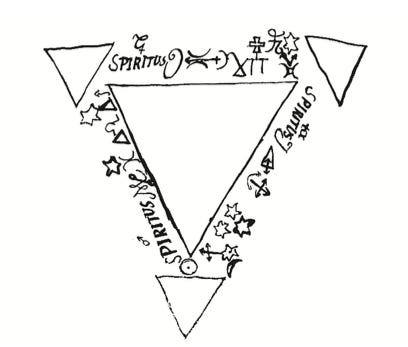
Erica Lagalisse, in Occult Features of Anarchism, reminds us that Marx’s “dialectical materialism” was built on Hegel, whose approach to the dialectic was heavily influenced the Corpus Hermeticum; that Newton himself considered himself an alchemist and devoted much of his life to “the Great Work”; and that Blavatsky’s theosophy and “root” races, combined with California eugenics, formed the basis for ariosophy, the “spiritual” doctrine behind Nazism:
The fact that Marx builds on Hegel who builds on the Hermetica does not necessarily mean they are wrong; it simply means that a vast amount of “rational” social theory relies on archetypes and geometries of thought stemming from a specific, historically situated cosmology—as does the notion of “rationality” itself […]
Socialism and occultism developed in complementary (as well as dialectical) fashion during the nineteenth century, yet the cosmological grounding of nineteenth-century anarchist politics is generally downplayed or treated as epiphenomenal in retrospect: just as Newton’s alchemy is largely ignored in mainstream histories of the scientific establishment, so Fourier’s law of passional attraction is rewritten in main-stream histories of the left as a vision of “a harmonious society based on the free play of passions.” It was only when Marxist “scientific socialism” became hegemonic during the twentieth century that the theological understandings of modern revolutionism were buried from consciousness among the popular and academic left.
The symbiosis of Blavatsky’s theosophy (involving “root races”) with eugenics, and the association of occult narratives and iconography with the rise of fascism, for example, have also often been pointed out, and of course the connections are there.12
SOON, PART 2: GHOST LEMURS OF MADAGASCAR, LEMURIAN TIME WAR
Schreiber, Brad. Revolution’s End, The Patty Hearst Kidnapping, Mind Control and Secret History of Donald Defreeze and the SLA. New York: Skyhorse Publishing, 2016.
Lagalisse, Erica. Occult Features of Anarchism With Attention to the Conspiracy of Kings and the Conspiracy of the Peoples. Oakland: PM Press, 2019.
McGowan, Todd. The Impossible David Lynch. New York: Columbia Univerisity Press, 2007.
Newman, Saul. Interrogating the Master: Lacan and Radical Politics in Psychoanalysis, Culture, and Society, Volume 9 (2004). Springer. Online: https://theanarchistlibrary.org/library/saul-newman-interrogating-the-master-lacan-and-radical-politics.pdf
Lynch, David. Online: http://thecityofabsurdity.com/projects.html
Bushman, David. Conversations with Mark Frost. New York: Fayetteville Mafia Press, 2020.
Greek Religion. Encyclopedia Brittanica. Online: https://www.britannica.com/topic/Greek-religion/Sacred-writings
Toronto, Richard. War over Lemuria, Richard Shaver, Ray Palmer and the Strangest Chapter of 1940s Science Fiction . London: McFarland & Company, 2013.
ibid.
Frost, Mark. The Secret History of Twin Peaks. New York: Macmillan, 2016.
ibid.
Lagalisse, Erica. Occult Features of Anarchism With Attention to the Conspiracy of Kings and the Conspiracy of the Peoples. Oakland: PM Press, 2019.